

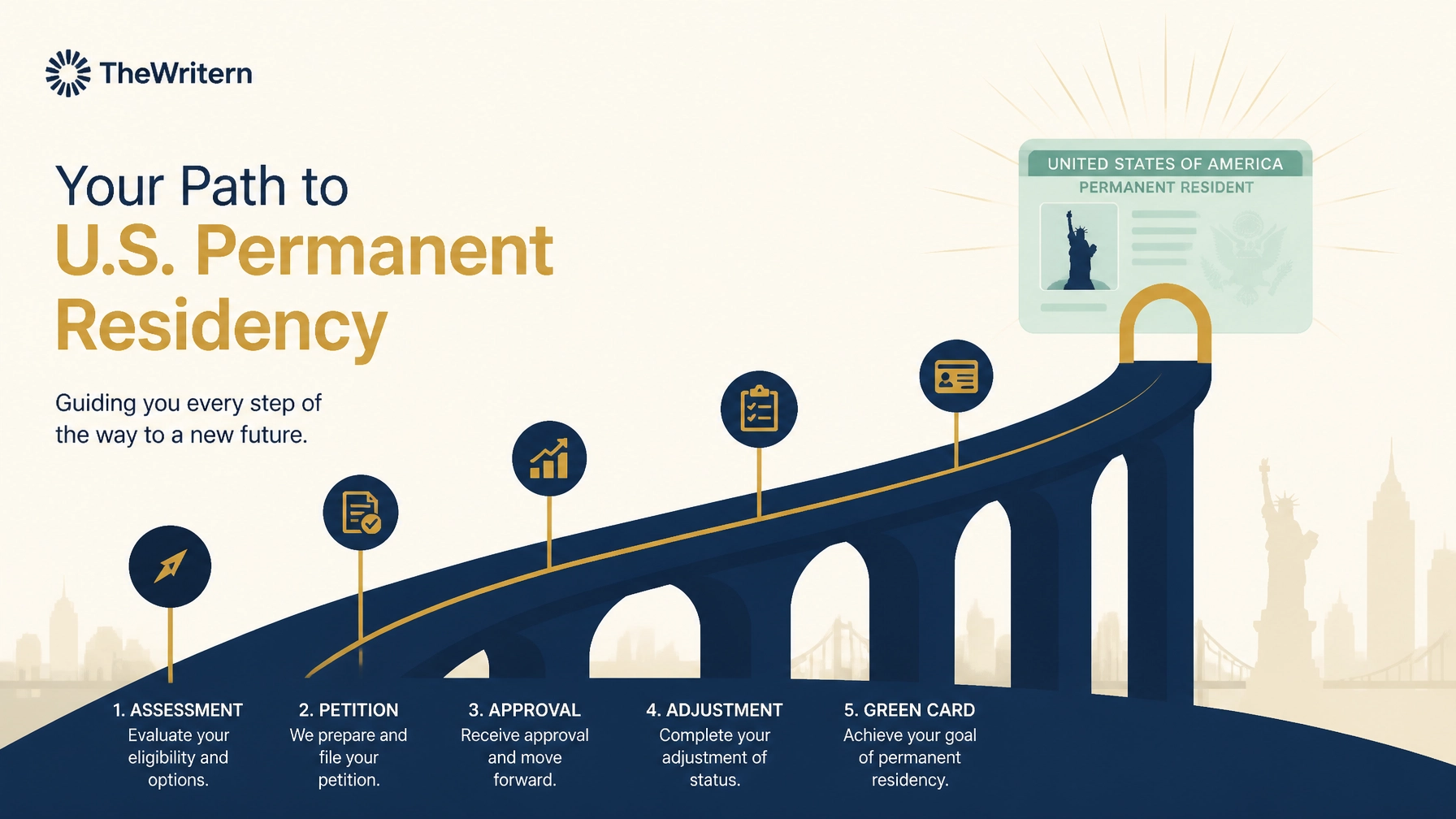
Securing a permanent employment-based visa, commonly referred to as a "Green Card," is a multi-phased administrative process governed by the U.S. Department of Labor (DOL) and U.S. Citizenship and Immigration Services (USCIS). For employers and foreign nationals, this process requires strict adherence to regulatory timelines, evidentiary standards, and procedural formalities. Failure to comply with these requirements can result in administrative denials, significant delays, or legal penalties.
This guide outlines the five primary steps required to transition from a temporary work visa to lawful permanent residency through employment-based sponsorship, specifically focusing on the EB-2 and EB-3 categories which require a labor market test.
Step 1: Prevailing Wage Determination and Job Definition
The initial phase of the employment-based green card process is the definition of the position and the acquisition of a Prevailing Wage Determination (PWD). This step ensures that the employment of a foreign national does not adversely affect the wages and working conditions of similarly employed U.S. workers.
The employer must first establish the minimum requirements for the position, including education, experience, and specific skill sets. These requirements must be "normal" for the occupation in the United States and cannot be tailored specifically to the foreign national's background. Once the job description is finalized, the employer submits a request to the DOL via Form ETA-9141.
The DOL reviews the job duties and location to issue a PWD, which specifies the minimum salary the employer must pay the foreign national upon the approval of the green card. This determination is binding; the employer must demonstrate the financial capacity to pay this wage from the moment the labor certification is filed.
Step 2: Recruitment and PERM Labor Certification
The Program Electronic Review Management (PERM) process is a mandatory labor market test. The employer must prove to the DOL that there are no "able, willing, qualified, and available" U.S. workers to fill the position offered to the foreign national.

Mandatory Recruitment Activities
To satisfy PERM requirements, the employer must conduct a series of recruitment activities, including:
- Job Order: Placing a 30-day job order with the State Workforce Agency (SWA) in the state of intended employment.
- Newspaper Advertisements: Placing advertisements in two consecutive Sunday editions of a newspaper of general circulation in the area of intended employment.
- Internal Posting: Posting a notice of the job opportunity at the worksite for ten consecutive business days.
For professional positions, the employer must also complete three additional recruitment steps, such as posting on the company website, utilizing a private employment firm, or advertising on a job search website.
Filing Form ETA-9089
Upon completion of the recruitment period and a mandatory 30-day "quiet period" to allow for applicant responses, the employer files Form ETA-9089 with the DOL. The employer must document every U.S. applicant and provide lawful, job-related reasons for their rejection. The DOL may audit the application, requiring the submission of all recruitment evidence for government review. An approved PERM certification is valid for 180 days, during which the subsequent immigrant petition must be filed.
Expert legal guidance is essential during this stage to ensure recruitment efforts meet the highly technical standards of the DOL. Organizations often benefit from Human Resources Immigration Solutions to manage these complex compliance requirements.
Step 3: The Immigrant Petition (Form I-140)
Once the DOL certifies the PERM application, the employer proceeds to the second major stage: filing Form I-140, Immigrant Petition for Alien Worker, with USCIS. This petition establishes the foreign national’s eligibility for the specific immigrant visa category (e.g., EB-2 or EB-3).

Burden of Proof for the Employer
The employer bears the burden of proving two critical elements:
- Ability to Pay: The employer must provide financial documentation, such as federal tax returns, audited financial statements, or annual reports, demonstrating the ability to pay the prevailing wage from the PERM filing date through the present.
- Validity of the Job Offer: The employer must confirm that the job offer is permanent, full-time, and matches the specifications approved in the PERM certification.
Burden of Proof for the Employee
The foreign national must demonstrate that they met all the minimum requirements for the position: including degrees, certifications, and years of experience: prior to the date the PERM was filed. This is typically achieved through the submission of educational evaluations and letters of experience from former employers.
USCIS offers "Premium Processing" for Form I-140 for an additional fee, which guarantees an adjudication or a Request for Evidence (RFE) within 15 business days.
Step 4: Priority Dates and the Visa Bulletin
Approval of the I-140 petition does not grant immediate permanent residency. The foreign national must wait for a visa number to become available, as determined by their "priority date." The priority date is generally the date the PERM application was originally filed with the DOL.

The U.S. Department of State publishes a monthly Visa Bulletin that tracks the availability of immigrant visas based on the applicant’s country of birth and visa preference category. If the demand for visas in a particular category exceeds the annual numerical limits, a backlog occurs.
Applicants must monitor the Visa Bulletin to determine when their priority date is "current." Only when the priority date is current can the final application for residency be submitted. Managing these timelines is a critical component of Workforce Compliance, as employees must maintain a valid non-immigrant status while waiting for their priority date to mature.
Step 5: Adjustment of Status or Consular Processing
The final step is the application for the actual Green Card. This is performed through one of two procedural paths:
1. Adjustment of Status (Form I-485)
If the foreign national is lawfully present within the United States, they may file Form I-485, Application to Register Permanent Residence or Adjust Status. This application includes:
- Biometrics: Digital fingerprints and photographs for background and security checks.
- Medical Examination: Form I-693, completed by a USCIS-designated civil surgeon.
- Work and Travel Authorization: Applicants may concurrently file for an Employment Authorization Document (EAD) and Advance Parole (AP) to allow for work and international travel while the I-485 is pending.
2. Consular Processing
If the foreign national is located outside the United States, they must undergo consular processing. This involves submitting documentation to the National Visa Center (NVC) and attending an interview at a U.S. Embassy or Consulate in their home country. Upon approval, the individual receives an immigrant visa and becomes a lawful permanent resident upon entry into the U.S.

Conclusion
The transition to permanent employment in the United States is a rigorous process that demands precision at every stage. From the initial prevailing wage request to the final adjudication of the green card application, employers and employees must navigate a complex landscape of federal regulations.
Blasingame Law LLC provides comprehensive Business Immigration Solutions for companies seeking to retain their international talent. Our experienced legal team offers the authoritative guidance necessary to manage PERM certifications, immigrant petitions, and long-term compliance strategies.
For expert assistance with your employment-based immigration needs, contact Blasingame Law LLC to schedule a formal consultation.