

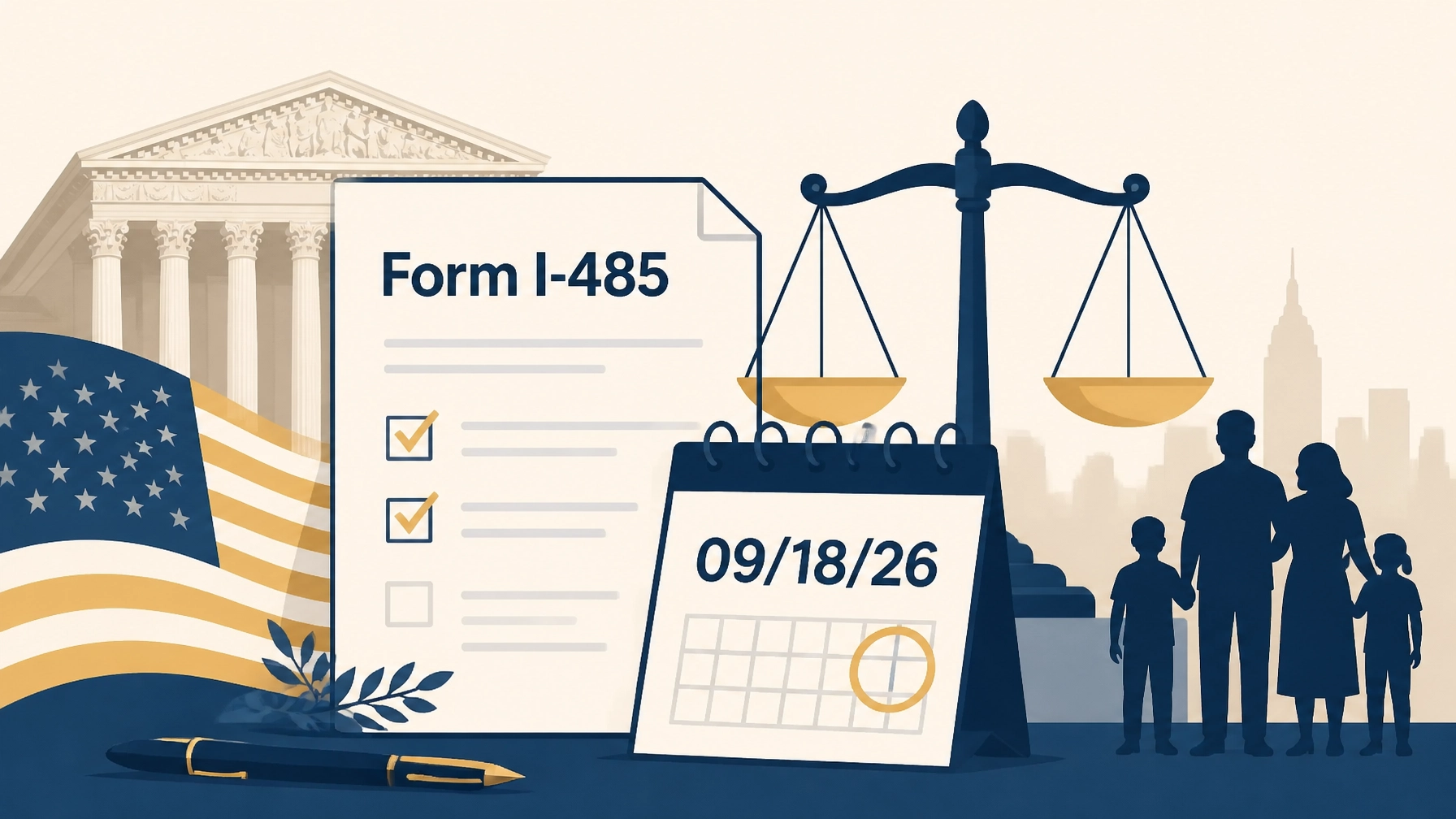
The Department of Homeland Security (DHS) will implement significant changes to the public charge ground of inadmissibility on September 18, 2026. The final rule rescinds the 2022 public charge regulations and restores a broader, individualized review based on the totality of the circumstances.
The change directly affects many green card applicants filing Form I-485, Application to Register Permanent Residence or Adjust Status. USCIS will require a new Form I-485 edition dated 09/18/26. There will be no grace period for using the prior edition.
Family-based applicants, employment-based applicants, sponsors, and immigration professionals should review their filing strategy before the effective date.
What the 2026 Public Charge Rule Changes
Section 212(a)(4) of the Immigration and Nationality Act (INA), 8 U.S.C. § 1182(a)(4), provides that a person may be inadmissible if the person is likely at any time to become a public charge.
The 2026 final rule removes the regulatory framework established by the 2022 public charge regulations, including provisions in 8 C.F.R. §§ 212.20 through 212.23. DHS stated that the 2022 framework was too restrictive because it limited the information officers could consider.
Beginning September 18, 2026, USCIS officers will make individualized, case-specific determinations. Officers will consider the applicant’s complete circumstances rather than applying a narrow list of benefits, thresholds, or regulatory definitions.
The final rule requires consideration of five statutory factors:
- Age
- Health
- Family status and household circumstances
- Assets, resources, and financial status
- Education and skills
Officers may also consider:
- The applicant’s receipt of means-tested public benefits
- The applicant’s Form I-864, Affidavit of Support, when required
- Other relevant evidence concerning the applicant’s ability or potential ability to remain self-sufficient
- The circumstances, duration, and amount of any benefits received
Receipt of one benefit is not automatically outcome-determinative. USCIS must evaluate the relevant evidence in the totality of the circumstances. However, the broader framework gives officers greater discretion to determine the weight assigned to benefit use and other financial or personal circumstances.

The New Form I-485 Edition Is Mandatory
USCIS will publish the revised Form I-485 with an edition date of 09/18/26. The new edition replaces the 01/20/25 edition.
USCIS has expressly stated that there is no transition period:
- USCIS will accept the 01/20/25 edition if it is postmarked or electronically submitted before September 18, 2026.
- USCIS will reject the 01/20/25 edition if it is postmarked or electronically submitted on or after September 18, 2026.
- USCIS will accept the 09/18/26 edition only if it is postmarked or electronically submitted on or after September 18, 2026.
- Applicants must not use the 09/18/26 edition before the effective date.
A rejected filing can result in lost time, additional filing costs, and the loss of a filing date that may be important for work authorization, travel authorization, or visa availability.
Applicants should review the official USCIS Form I-485 page and use the correct edition for the date the filing will be submitted. All pages of a paper filing should come from the same edition, and the edition date and page numbers must be visible.
What Changes in Part 9 of Form I-485
The revised public charge questions appear in Part 9, General Eligibility and Inadmissibility Grounds.
Applicants must first address the public charge exemption question in Item 56. The applicant must identify whether the immigration category is exempt from the public charge ground of inadmissibility.
If the applicant qualifies for an exempt category, the applicant may select the applicable exemption and skip the subsequent public charge questions. If the applicant does not qualify for an exemption, the applicant must select the option stating that the applicant is not exempt and complete Items 57 through 66.
The revised Part 9 requests information relevant to the mandatory statutory factors, including:
- Family status and household composition
- Household income
- Assets and resources
- Liabilities and financial obligations
- Education and training
- Occupational skills and certifications
- Work history and employment-related information
- Receipt of means-tested public benefits
- The dates, amounts, and circumstances of benefit receipt
The revised form also changes the treatment of skills-related information. Applicants should continue to list relevant certifications, licenses, skills obtained through work experience, educational certificates, and other qualifications.
Applicants required to submit a medical examination must also submit Form I-693, Report of Immigration Medical Examination and Vaccination Record. USCIS may consider the medical examination as evidence relevant to the health factor.
How USCIS Will Consider Public Benefits by Date
The rule creates an important distinction between benefits received before September 18, 2026, and benefits received on or after that date.
Benefits received before September 18, 2026
For means-tested benefits received before the effective date, USCIS will apply the 2022 framework. USCIS will consider only:
- Public cash assistance for income maintenance
- Long-term institutionalization at government expense
Previously excluded non-cash benefits received before September 18, 2026 generally will not be considered under the new rule. Examples may include benefits such as:
- Supplemental Nutrition Assistance Program (SNAP)
- Medicaid, subject to the applicable rules
- Housing assistance
- Other non-cash means-tested benefits
The final rule also addresses applications, certifications, and approvals for benefits. If an applicant was approved or certified for benefits before September 18, 2026, but the benefit continues into the period after the effective date, the post-effective-date receipt may be considered if the applicant does not provide evidence of disenrollment or withdrawal.
Applicants should preserve records showing:
- The date benefits began
- The date benefits ended
- The type of benefit
- The amount received
- Whether the benefit was received by the applicant or another household member
- Any notice showing withdrawal, termination, or disenrollment
Benefits received on or after September 18, 2026
For applications governed by the 2026 rule, USCIS may consider any means-tested public benefit received on or after the effective date.
This may include cash and non-cash assistance, such as:
- Cash assistance
- Food assistance
- Housing assistance
- Means-tested health care benefits
- Financial aid or similar programs
The benefit is one part of the analysis. USCIS will consider the amount, duration, purpose, and circumstances of receipt together with the applicant’s age, health, family status, finances, education, skills, and other relevant evidence.
The rule does not change eligibility for public benefits. It does not prohibit a state or federal agency from providing benefits to an individual who qualifies under applicable law. It changes how benefit receipt may be evaluated in an immigration inadmissibility determination.
Family Members’ Benefits and Household Information
USCIS generally will not attribute a family member’s receipt of public benefits to the applicant. A U.S. citizen child’s receipt of benefits, for example, is not automatically treated as the parent’s receipt of benefits.
However, household circumstances remain relevant. USCIS may consider:
- The applicant’s legal obligation to support family members
- Household size and composition
- The applicant’s income and financial resources
- Whether family members depend on the applicant
- Whether a family member’s benefit eligibility is based on the applicant’s income
Applicants must answer the Form I-485 questions accurately. They must not report benefits received by another person as the applicant’s own benefits. At the same time, applicants must provide complete household and financial information when the form requests it.
An inaccurate answer can create separate immigration consequences, including a finding of fraud or willful misrepresentation under INA § 212(a)(6)(C)(i).
What Sponsors Should Prepare
Most family-based immigrants and some employment-based immigrants must submit Form I-864, Affidavit of Support Under Section 213A of the INA.
The sponsor should prepare evidence demonstrating the ability to maintain the intending immigrant at the required income level. Depending on the case, the sponsor should collect:
- Federal tax returns and tax transcripts
- W-2 forms and 1099 forms
- Recent pay statements
- Employment verification
- Proof of assets
- Evidence of household size
- Documentation for a joint sponsor, if necessary
- Proof of lawful permanent resident or U.S. citizen status
The Form I-864 is a legally enforceable contract. The sponsor may have an obligation to provide financial support and, in certain circumstances, reimburse a benefit agency for means-tested benefits received by the sponsored immigrant.
A sufficient Form I-864 does not eliminate the need to provide accurate Form I-485 information. USCIS may consider the affidavit together with the applicant’s complete circumstances.

Practical Preparation Steps for Green Card Applicants
Applicants who may file before or after September 18, 2026 should take the following steps:
- Confirm the filing date. Determine whether the application will be postmarked or electronically submitted before or after September 18, 2026.
- Use the correct Form I-485 edition. Do not submit the 09/18/26 edition before the effective date. Do not submit the 01/20/25 edition on or after the effective date.
- Determine whether the category is exempt. Humanitarian categories, VAWA self-petitions, U and T nonimmigrants, refugees, asylees, Special Immigrant Juveniles, and other categories may be exempt. Exemptions depend on the precise immigration classification.
- Document benefits history. Gather agency notices and account records showing the type, amount, and dates of any benefits received.
- Separate the applicant’s benefits from family members’ benefits. Do not combine the records or misidentify the recipient.
- Prepare financial evidence. Organize income, assets, liabilities, employment, and household documentation.
- Prepare education and skills evidence. Include diplomas, certifications, licenses, employment records, and other evidence of occupational qualifications.
- Complete the medical examination when required. Submit Form I-693 according to current USCIS requirements.
- Review the Form I-864. Confirm that the sponsor meets the income requirement or identify whether a joint sponsor or qualifying assets may be necessary.
- Obtain case-specific legal advice. The totality-of-the-circumstances review is individualized. A general checklist cannot determine whether a particular applicant is likely to be found inadmissible.
The final rule increases the importance of accurate preparation. A green card applicant should not assume that family sponsorship alone resolves public charge concerns, and an applicant should not assume that one benefit automatically results in denial.
Consult an Immigration Lawyer Before Filing
The public charge rule effective September 18, 2026, changes both the legal framework and the information collected through Form I-485. The absence of a grace period creates an additional filing risk.
An experienced immigration lawyer can review the applicant’s category, filing date, benefits history, household circumstances, medical evidence, financial records, and Form I-864 before submission.
Blasingame Law LLC provides personalized guidance for family-based green cards, adjustment of status, consular processing, affidavits of support, and complex immigration matters. With more than 30 years of experience in U.S. immigration law, our firm helps individuals and families prepare accurate filings under changing legal requirements.
Schedule a confidential consultation with Blasingame Law LLC or learn more about our family immigration services.
This article provides general information and does not constitute legal advice. Immigration rules and USCIS instructions may change. Applicants should rely on the current USCIS form, instructions, Policy Manual guidance, and advice regarding their specific circumstances.