

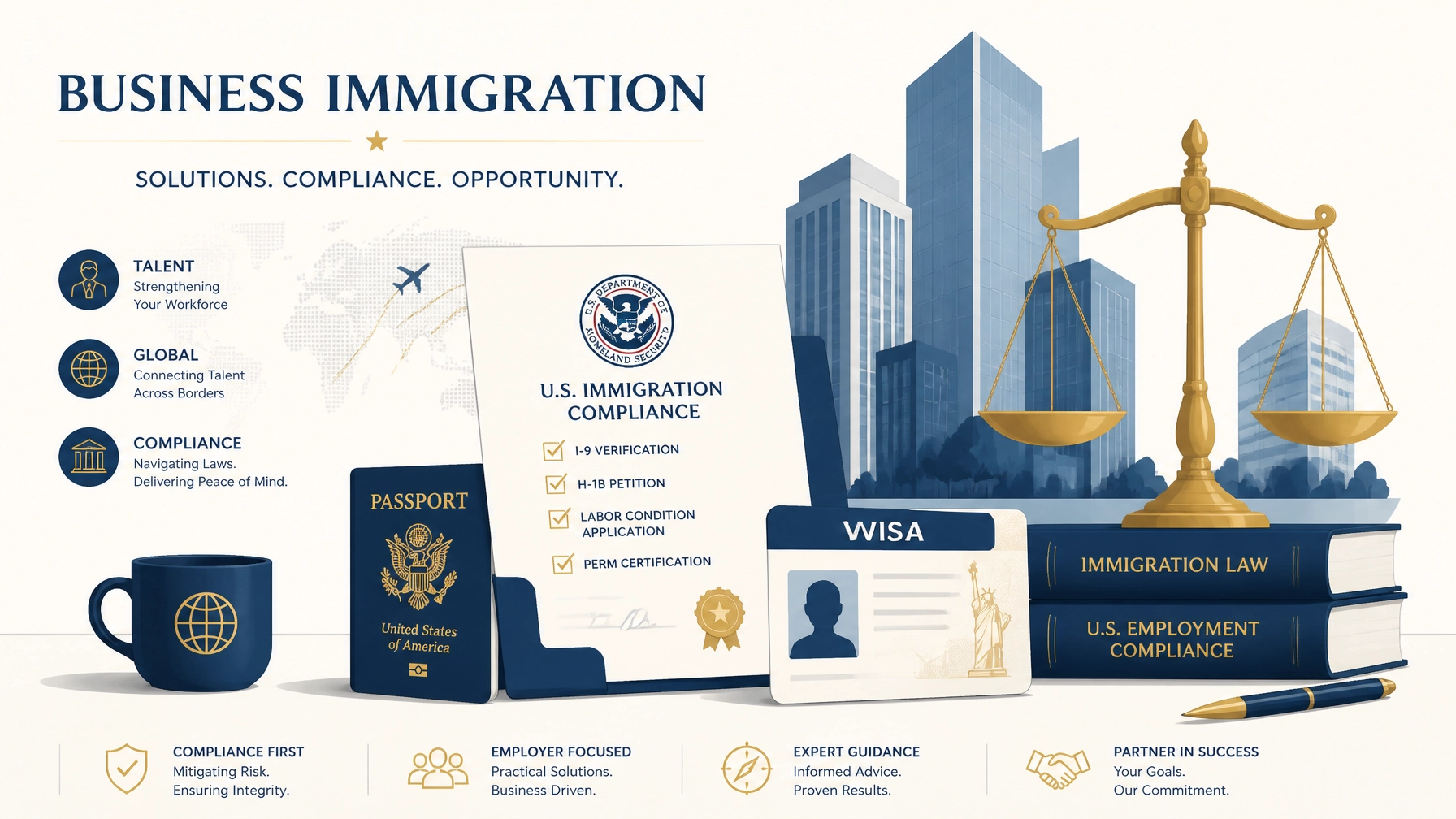
The United States business immigration landscape in 2026 introduces significant regulatory shifts, heightened financial obligations, and rigorous compliance mandates for employers sponsoring foreign national talent. Human resources departments and corporate legal counsel must adapt immediately to sweeping changes in the H-1B cap selection process, fee structures, and administrative requirements, while simultaneously evaluating alternative pathways such as the L-1 intracompany transferee visa.
Failure to adhere to these updated federal standards results in severe legal liabilities, financial penalties, and operational disruptions. Blasingame Law LLC provides expert guidance and strategic solutions to help employers navigate complex workforce compliance and business immigration requirements.
H-1B Program Regulatory Updates for 2026
The H-1B nonimmigrant visa program remains subject to rigorous administrative oversight, higher financial thresholds, and refined selection mechanisms. Employers utilizing the H-1B program must account for several critical updates enforced by United States Citizenship and Immigration Services (USCIS) and the Department of Labor (DOL).
Electronic Registration and Fee Structures
The H-1B electronic registration system mandates strict adherence to financial and procedural timelines:
- Registration Fee: The non-refundable H-1B electronic registration fee is $215 per beneficiary. This fee applies regardless of whether the registration is selected in the lottery.
- Daily Transaction Limits: Financial institutions and corporate treasuries must verify daily credit card transaction limits, which are capped to accommodate bulk employer filings.
- Budgetary Planning: Employers must pre-fund registration accounts and isolate petition filing costs from general operating budgets prior to opening registration windows.
The Wage-Weighted H-1B Lottery Selection System
USCIS implements a wage-weighted selection methodology for the H-1B cap lottery, moving away from a purely random selection model for cap-subject petitions:
- Level I Prevailing Wage: Registrants meeting the entry-level wage receive 1 lottery entry.
- Level II Prevailing Wage: Registrants meeting the qualified wage receive 2 lottery entries.
- Level III Prevailing Wage: Registrants meeting the experienced wage receive 3 entries.
- Level IV Prevailing Wage: Registrants meeting the fully competent, highly experienced wage receive 4 entries.
This weighted system heavily favors senior positions and higher compensation tiers. Junior roles at Level I face diminished selection probabilities, requiring employers to restructure recruitment compensation bands or explore alternative visa categories.

The $100,000 Statutory Supplemental Fee
Following administrative implementation and subsequent litigation resolution, USCIS enforces a $100,000 statutory supplemental fee on specific H-1B filings:
- Applicability: The fee applies to new H-1B petitions filed with consular notification where the foreign national is physically outside the United States and does not hold active H-1B status.
- Exemptions: Change-of-status petitions originating from within the United States (such as students transitioning from F-1 status) and standard extensions of status for current H-1B employees are generally exempt from this supplemental fee.
- Compliance Directive: Corporate immigration programs must prioritize in-country changes of status where legally permissible to mitigate prohibitive onboarding expenditures.
Administrative and Procedural Compliance Mandates
Beyond lottery and fee modifications, operational compliance requires strict adherence to updated federal forms and adjudication protocols.
Mandatory Form I-129 Edition
USCIS strictly enforces the current edition of Form I-129 (Petition for a Nonimmigrant Worker).
- Previous editions of Form I-129 are obsolete and rejected upon submission.
- HR teams must update internal document repositories, template libraries, and electronic HRIS platforms to ensure all active filings utilize the correct form version.
- Submissions lacking correct form editions or requisite fee remittances face immediate rejection, jeopardizing employee work authorization validity periods.
Premium Processing Fee Adjustments
Expedited adjudication through USCIS premium processing is subject to adjusted fee schedules across employment-based classifications. Employers utilizing Form I-907 for accelerated processing must verify current fee amounts prior to filing to prevent processing delays. For foundational guidance on integrating these procedures into corporate onboarding, review our introduction to immigration for human resources.

Strategic Utilization of L-1 Intracompany Transferee Visas
Given the rising costs, wage-weighting hurdles, and supplemental fees associated with the H-1B cap, multinational corporations increasingly rely on L-1 intracompany transferee visas to transfer key personnel to U.S. operations.
Core Eligibility Criteria for L-1 Visas
To qualify for an L-1 visa, the corporate entity and the employee must satisfy rigorous statutory requirements:
- Qualifying Corporate Relationship: The foreign entity and the U.S. petitioner must maintain a parent, branch, subsidiary, or affiliate relationship.
- Prior Foreign Employment: The beneficiary must have been employed abroad continuously for at least one full year within the three years preceding the filing of the petition.
- Qualifying Capacity: The employment abroad and the proposed U.S. position must fall strictly within one of two statutory categories:
- L-1A (Managers and Executives): Directing an organization, department, or function with supervisory authority over professional staff and executive decision-making power.
- L-1B (Specialized Knowledge): Possessing specialized knowledge of the petitioning organization's product, service, research, equipment, techniques, management, or international markets.
Advantages of L-1 Visas Over H-1B
- No Annual Cap: The L-1 program is not subject to an annual numerical cap or lottery selection mechanism, providing predictable timing for corporate deployment.
- Duration Limits: L-1A status is granted for an initial period of up to three years, extendable up to a maximum of seven years. L-1B status allows a maximum duration of five years.
- Dual Intent Recognition: L-1 classification explicitly recognizes dual intent, allowing transferees to pursue permanent residency (employment-based green cards) without violating nonimmigrant status.
For comprehensive business structuring advice, explore our dedicated business immigration solutions.
Employer Obligations and Risk Management
Immigration compliance extends beyond initial visa approval. Federal authorities enforce strict worksite obligations and wage requirements.
Prohibition of Improper Fee-Sharing and Cost-Shifting
Employers are legally obligated to bear statutory employer-specific fees associated with H-1B and L-1 petitions.
- Deducting or shifting H-1B training and fraud prevention fees to the employee violates federal labor standards.
- Employers operating in jurisdictions with strict "stay-or-pay" restrictions (such as California) must review repayment agreements to ensure compliance with state and federal wage laws governing training cost recovery.
Form I-9 and Worksite Compliance
Corporate employers must maintain rigorous Form I-9 employment eligibility verification records for all sponsored workers. Internal audits and government enforcement actions by ICE require meticulous recordkeeping, timely reverification of work authorization expiration dates, and adherence to anti-discrimination mandates.
Conclusion and Next Steps
Navigating the 2026 business immigration environment requires vigilance, precision, and proactive strategic planning. The convergence of wage-weighted lotteries, substantial supplemental fees, and rigorous enforcement demands expert legal oversight.
To safeguard your organization's talent acquisition pipeline and ensure absolute regulatory compliance, schedule a professional consultation with Blasingame Law LLC. Contact our firm directly through our contact us page or schedule an appointment via our consultation portal to speak with an experienced immigration attorney today.