

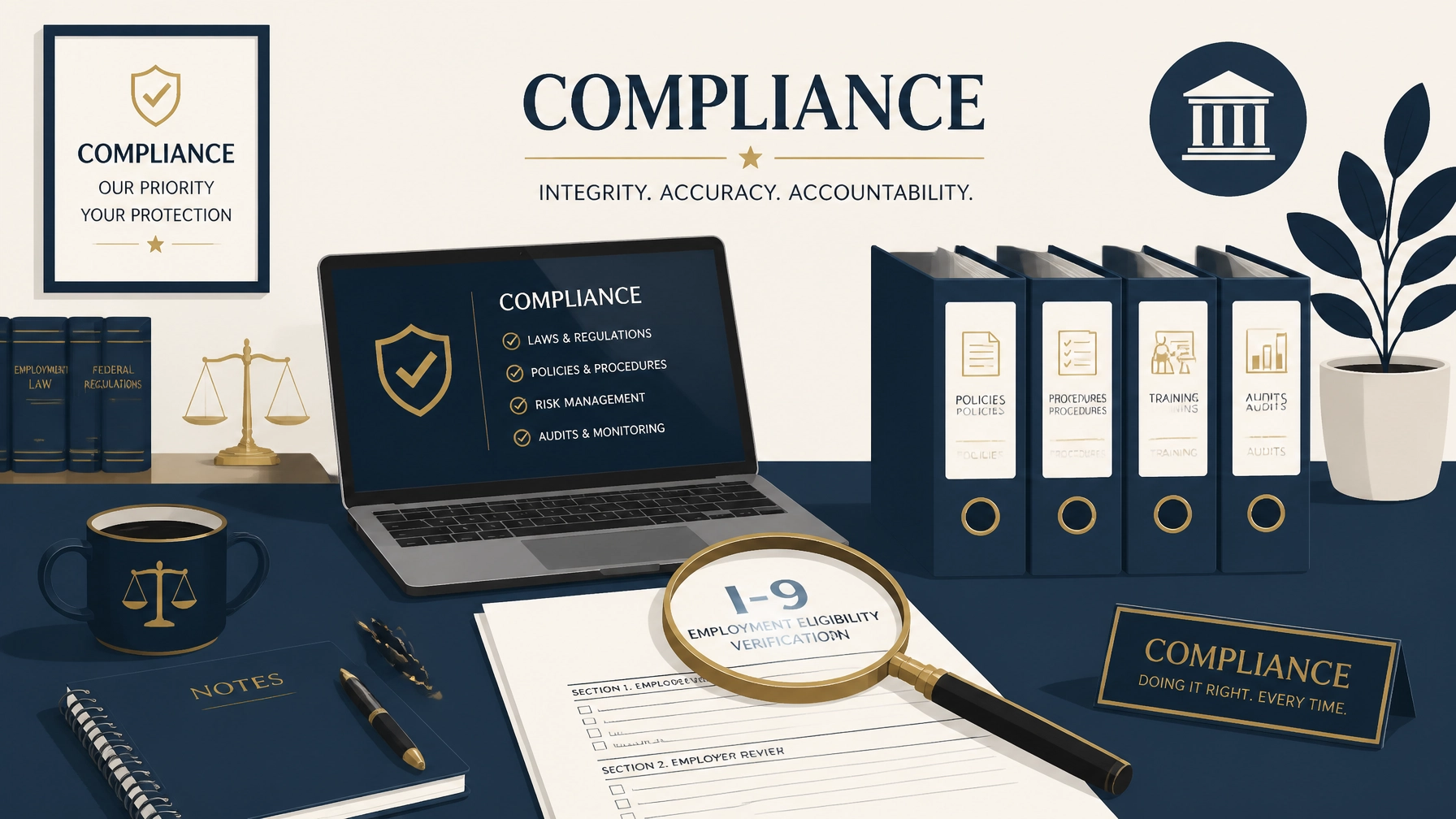
Maintaining rigorous workforce compliance is a mandatory operational requirement for all United States employers. As the Department of Homeland Security (DHS) and Immigration and Customs Enforcement (ICE) continue to refine their oversight mechanisms in 2026, the necessity for a proactive internal I-9 audit has never been more critical. This guide provides a formal, step-by-step framework for HR departments and business owners to evaluate their Form I-9 records, identify deficiencies, and implement legally compliant corrections.
The Imperative for Internal I-9 Audits in Modern Workforce Compliance
Federal law requires employers to verify the identity and employment authorization of every individual hired after November 6, 1986. Failure to maintain accurate and complete Form I-9 records can result in substantial civil penalties, ranging from several hundred to several thousand dollars per violation. In 2026, the complexity of these requirements is compounded by the integration of remote verification protocols and the expanded use of E-Verify.
An internal I-9 audit serves as a primary defensive measure against government inspections. By conducting a self-review, an organization can:
- Mitigate Financial Risk: Identifying and correcting technical errors in a "good-faith" manner can significantly reduce potential fines during an official ICE inspection.
- Ensure Operational Continuity: Regular audits prevent the sudden discovery of unauthorized workers, which can disrupt business operations and lead to legal exposure.
- Standardize Procedures: Audits highlight systemic failures in the onboarding process, allowing HR departments to implement better training and oversight.
Consistent internal reviews are the cornerstone of a robust workforce compliance program.

Establishing the Scope of Your Internal I-9 Audit
A systematic audit begins with defining the scope and organizing the data. Employers must ensure that every active employee on the payroll has a corresponding Form I-9, while also adhering to strict document retention schedules.
1. Assemble the Audit Roster
Generate a comprehensive list of all current employees from the Human Resources Information System (HRIS) or payroll records. This roster must include:
- Full legal name
- Hire date
- Current employment status
- Termination date (if applicable)
2. Apply Retention Rules
Employers are not required to keep Form I-9s indefinitely. For terminated employees, the form must be retained for the later of:
- Three years after the date of hire; or
- One year after the date employment terminated.
Forms that fall outside this window should be identified and securely destroyed to minimize data privacy risks and unnecessary liability.
3. Identify Missing Documentation
Compare the active employee roster against the physical or electronic I-9 files. Any employee without a form on file represents an immediate compliance risk. If a form is missing, the employer must initiate the completion of a new Form I-9 immediately.
Step-by-Step Methodology for Individual Form Review
Once the roster is reconciled, each individual Form I-9 must be examined for completeness, accuracy, and timeliness. This review should be conducted using a standard checklist to ensure consistency.
Section 1: Employee Information and Attestation
The employee must complete Section 1 no later than the first day of employment. Verify the following:
- Personal Data: All fields (name, address, date of birth) are filled. Use "N/A" for optional fields that are not applicable.
- Immigration Status: One of the four status boxes must be checked. If the employee selects "A noncitizen authorized to work," ensure they have provided an Alien/USCIS Number or Form I-94 Admission Number.
- Signature and Date: The employee must sign the form and enter the date. The date must not be backdated.
Section 2: Employer Review and Verification
Section 2 must be completed within three business days of the employee's start date. Reviewers must confirm:
- Document Validity: The documents presented must be unexpired and appear on the "Lists of Acceptable Documents."
- Data Accuracy: The document title, issuing authority, document number, and expiration date must be recorded accurately.
- Certification: The employer representative must sign, date, and provide their business title and address.
Supplement B: Reverification and Rehires
If an employee’s work authorization has expired, or if a previously terminated employee is rehired within three years, Supplement B (formerly Section 3) must be reviewed for current authorization details and timely signatures.

Identifying and Classifying Common I-9 Errors
During the I-9 audit, errors are generally classified into two categories: technical (administrative) and substantive.
- Technical Errors: These include minor omissions such as a missing zip code, failure to include "N/A" in empty fields, or a missing business address. DHS typically provides a ten-day period to correct these issues after a Notice of Inspection.
- Substantive Errors: These are major violations that can lead to immediate fines. Examples include:
- Failure to sign Section 1 or Section 2.
- Accepting expired documents.
- Failure to complete Section 2 within the 3-day window.
- Failure to conduct reverification for expiring work permits.
Identifying these issues internally allows the organization to document their discovery and correction, which demonstrates a good-faith effort to comply with the law.
Protocol for Correcting Errors and Omissions
Correcting errors discovered during an internal audit requires strict adherence to DHS guidelines. Failure to follow the correct procedure can be interpreted as tampering or fraud.
The Uniform Correction Method
For any error identified on a paper or printed form:
- Draw a single line through the incorrect information. Ensure the original entry remains legible.
- Enter the correct information clearly above or near the original entry.
- Initial and date the correction. Always use the current date. Never backdate a correction to the original hire date.
Correcting Section 1
Only the employee can correct errors in Section 1. If the employee is no longer with the company and the error is substantive, the employer should attach a signed and dated memorandum explaining the deficiency. If the employee is still active, they must be called upon to make the corrections themselves, initialing and dating the changes.
Correcting Section 2
Corrections in Section 2 must be made by an authorized employer representative. If the original representative is no longer available, a current representative may make the correction, initial it, and add a note explaining that the correction was made during an internal audit.
Discovery of a Missing Form
If no Form I-9 is found for a current employee:
- Immediately have the employee complete Section 1.
- The employer must complete Section 2 after reviewing original documents.
- Do not backdate. Use the current date for all signatures.
- Attach a signed memorandum explaining that the form was completed as part of an internal audit after discovering the original was missing.

Document Retention and Audit Finalization
An internal I-9 audit is not complete until the findings are documented and the records are reorganized for long-term storage.
The Audit Memorandum
Prepare a formal memorandum for the corporate record. This document should detail:
- The dates the audit was conducted.
- The name and title of the auditor(s).
- The scope of the review (e.g., "All active employees as of January 1, 2026").
- A summary of the findings and the specific actions taken to correct deficiencies.
Secure Storage
Forms should be stored separately from general personnel files to protect employee privacy and to ensure they are readily available in the event of an ICE investigation. In 2026, many organizations use encrypted digital storage; however, these systems must maintain a clear audit trail of all changes and signatures to satisfy federal requirements.
Securing Professional I-9 Compliance Services
The regulatory environment surrounding U.S. immigration and employment eligibility is subject to frequent and significant changes. While an internal review is a vital first step, the complexities of the law often require the expertise of specialized legal counsel.
Blasingame Law LLC offers comprehensive I-9 compliance services designed to protect your organization from legal liability and financial penalties. Our team provides expert guidance on workforce compliance, conducts high-level audits, and assists HR departments in developing defensive compliance strategies.

For a professional evaluation of your current I-9 practices or to schedule a comprehensive audit of your workforce records, contact Blasingame Law LLC today. Ensure your business is prepared for the regulatory challenges of 2026.