

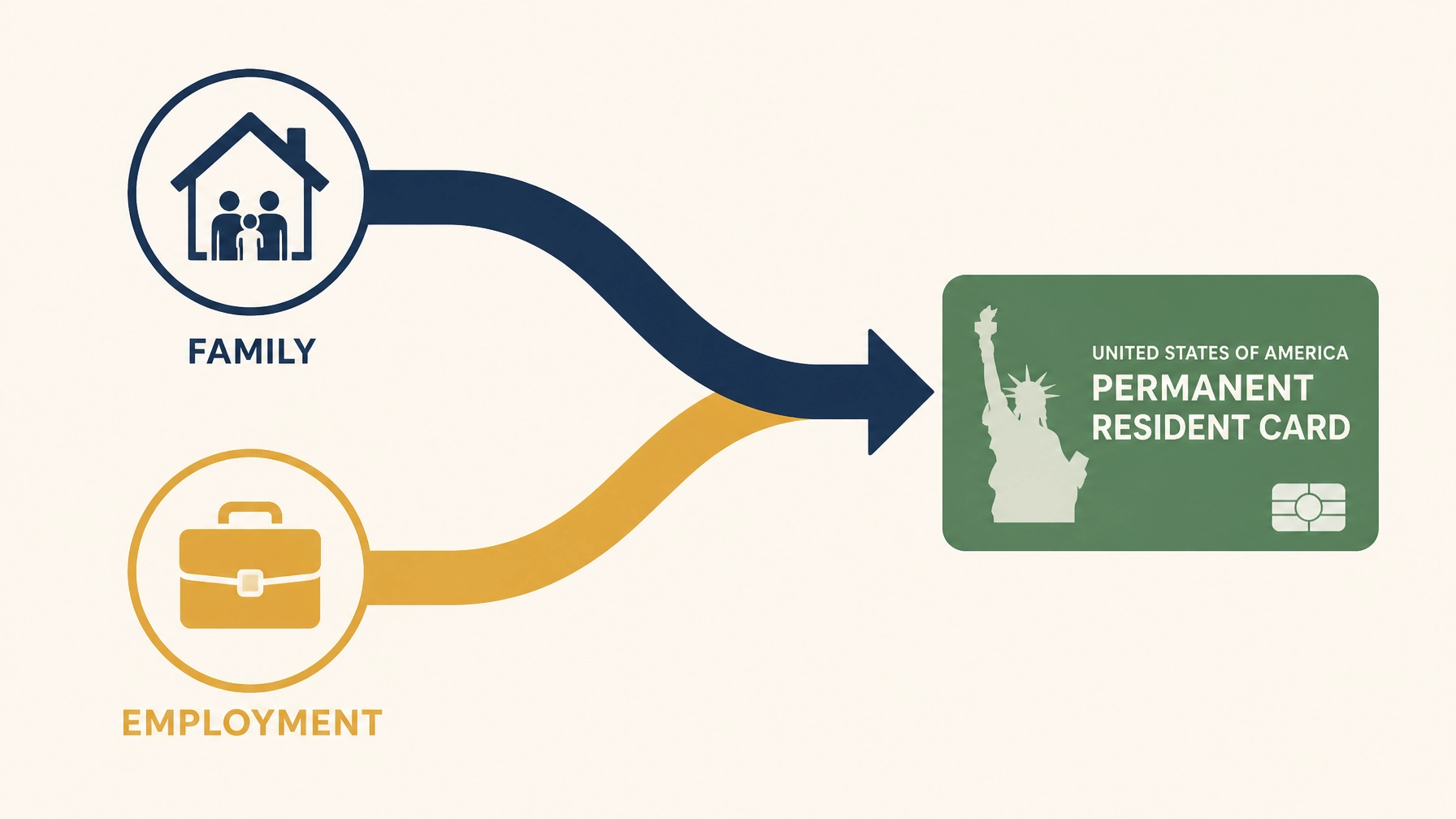
Lawful Permanent Residence (LPR), commonly referred to as holding a "Green Card," grants foreign nationals the authorization to live and work indefinitely within the United States. Obtaining this status requires navigating a complex legal framework defined by the Immigration and Nationality Act (INA). The two primary avenues for securing a Green Card are family-based and employment-based sponsorship. Each pathway is governed by distinct eligibility criteria, procedural requirements, and statutory quotas that significantly impact the duration and success of the application.
This guide provides a formal, comparative analysis of family-based versus employment-based immigration to assist individuals and organizations in determining the most viable legal strategy.
Understanding Family-Based Green Card Categories
Family-based immigration is predicated on a qualifying relationship with a U.S. citizen or a Lawful Permanent Resident. The law categorizes these relationships into two main groups: Immediate Relatives and Family Preference categories.
1. Immediate Relatives of U.S. Citizens
The Immediate Relative (IR) classification is the most advantageous category in U.S. immigration law because it is not subject to annual numerical limitations. Visas are always available for this group, meaning there is no waiting list beyond the standard processing time for the petition and application.
Qualifying immediate relatives include:
- Spouses of U.S. citizens.
- Unmarried children under 21 of U.S. citizens.
- Parents of U.S. citizens (provided the citizen petitioner is at least 21 years of age).
2. Family Preference Categories
All other qualifying family relationships fall into preference categories, which are subject to annual caps. Because demand often exceeds the statutory supply, applicants in these categories must wait for their "priority date" to become current as published in the Department of State’s monthly Visa Bulletin.
The preference hierarchy is as follows:
- First Preference (F1): Unmarried adult sons and daughters (age 21 and older) of U.S. citizens.
- Second Preference (F2A/F2B): Spouses and minor children of LPRs (F2A) and unmarried adult sons and daughters of LPRs (F2B).
- Third Preference (F3): Married sons and daughters of U.S. citizens.
- Fourth Preference (F4): Brothers and sisters of adult U.S. citizens.

Navigating Employment-Based Green Card Categories
Employment-based (EB) immigration allows U.S. employers to sponsor foreign nationals for permanent residence based on specific professional qualifications, labor needs, or substantial capital investment. Unlike family-based immigration, which focuses on relationships, the EB pathway emphasizes the economic and professional contribution of the applicant.
There are five primary employment-based preference categories:
1. EB-1: Priority Workers
This category is reserved for individuals with extraordinary ability in the sciences, arts, education, business, or athletics; outstanding professors and researchers; and certain multinational managers and executives. EB-1 applicants often bypass the lengthy labor certification process.
2. EB-2: Professionals with Advanced Degrees or Exceptional Ability
This category applies to professionals holding advanced degrees (beyond a baccalaureate degree) or persons of exceptional ability in the sciences, arts, or business. Most EB-2 cases require a job offer and a labor certification from the Department of Labor, although a National Interest Waiver (NIW) may be available for those whose work significantly benefits the United States.
3. EB-3: Skilled Workers, Professionals, and Other Workers
This category covers "skilled workers" (requiring at least two years of training or experience), "professionals" (requiring at least a U.S. baccalaureate degree or foreign equivalent), and "other workers" (performing unskilled labor requiring less than two years of training). All EB-3 petitions require a job offer and a labor certification.
4. EB-4: Special Immigrants
This broad category includes religious workers, special immigrant juveniles, certain broadcasters, and employees of international organizations.
5. EB-5: Immigrant Investors
The EB-5 program is designed for foreign investors who make a capital investment of $800,000 (in a Targeted Employment Area) or $1,050,000 into a new commercial enterprise that creates at least ten full-time jobs for qualifying U.S. workers.

Comparative Analysis: Key Differences in Requirements
Selecting the optimal pathway requires a thorough understanding of the technical differences in sponsorship obligations, financial requirements, and administrative procedures.
Procedural Petitions
The initial step for a family-based Green Card is the filing of Form I-130, Petition for Alien Relative. This form serves to establish the legitimacy of the familial relationship. In contrast, most employment-based pathways begin with Form I-140, Immigrant Petition for Alien Worker, or in the case of investors, Form I-526.
Financial Responsibility and Admissibility
Family-based sponsors must execute a legally binding Form I-864, Affidavit of Support. This document requires the sponsor to demonstrate an income of at least 125% of the Federal Poverty Guidelines. The sponsor assumes financial responsibility for the immigrant to ensure they do not become a "public charge."
Employment-based sponsorship focuses on the employer’s ability to pay the offered wage. The employer must provide evidence, such as annual reports or federal income tax returns, to prove they can sustain the employee’s salary from the time the priority date is established until the Green Card is granted.
The Role of Labor Certification
A critical hurdle in many employment-based cases (specifically EB-2 and EB-3) is the Permanent Employment Certification (PERM) process. The employer must conduct a recruitment campaign to prove that there are no able, willing, qualified, and available U.S. workers for the position. Family-based immigration has no such requirement to test the U.S. labor market.

Priority Dates and Waiting Periods
Statutory limits on visa issuance create significant variations in processing times. Understanding the "Priority Date" is essential for managing expectations.
- Family-Based Backlogs: While Immediate Relatives face no backlogs, certain preference categories, particularly F4 (siblings) and F3 (married children), currently experience wait times exceeding 10 to 15 years, depending on the applicant's country of birth.
- Employment-Based Backlogs: EB categories are also subject to per-country caps. For individuals from countries with high demand (such as India and China), the wait for an EB-2 or EB-3 visa can span decades. However, for many other countries, employment-based visas may be available much sooner than family preference visas.
- Visa Bulletin Monitoring: Applicants in any capped category must monitor the Department of State Visa Bulletin to determine when they are eligible to file for Form I-485, Adjustment of Status, or proceed with consular processing.
Determining the Best Pathway: Practical Considerations
The decision between family-based and employment-based sponsorship often depends on the following factors:
- Relationship Status: If the applicant is the spouse or minor child of a U.S. citizen, the family pathway is almost invariably the fastest and most direct route.
- Professional Credentials: For highly skilled professionals or those in specialized fields, the employment-based route may offer a more predictable timeline, especially if they qualify for EB-1 or a National Interest Waiver.
- Employer Support: Employment-based sponsorship requires a dedicated employer willing to undergo the PERM process and pay associated legal and filing fees. For many business immigration clients, this is a strategic investment in talent retention.
- Country of Chargeability: An applicant's country of birth heavily influences the wait times in preference categories. In some instances, a family-based petition may be slower than an employment-based one for the same individual.

Conclusion and Professional Guidance
Choosing between family-based and employment-based Green Card pathways involves more than identifying eligibility; it requires a strategic assessment of current federal regulations, visa availability, and long-term immigration goals. Errors in the initial petition or a failure to maintain underlying nonimmigrant status during a long wait can lead to denials or deportation proceedings.
Blasingame Law LLC provides comprehensive family immigration and business immigration services. With over thirty years of experience, our firm assists clients in navigating the nuances of I-130 and I-140 petitions, workforce compliance, and adjustment of status applications.
For a formal evaluation of your visa eligibility or to discuss corporate sponsorship strategies, please contact Blasingame Law LLC to schedule a professional consultation.