

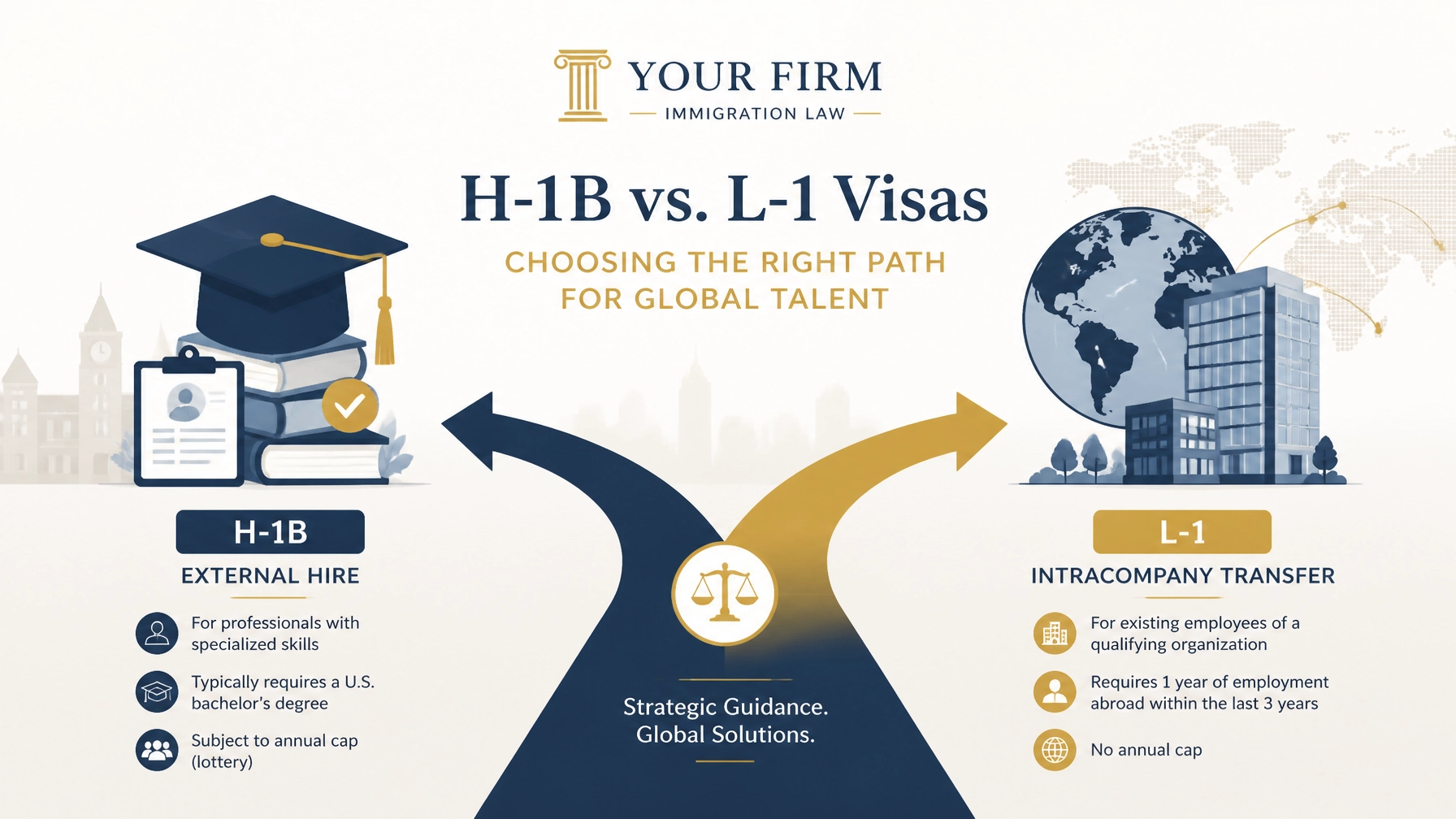
For organizations seeking to expand their domestic workforce or relocate international talent to the United States, selecting the appropriate visa category is a critical operational decision. The two most common pathways for business-related immigration are the H-1B Specialty Occupation visa and the L-1 Intracompany Transferee visa. Each classification is governed by distinct federal regulations, eligibility requirements, and procedural constraints.
Failure to select the optimal visa category can result in significant recruitment delays, increased legal expenditures, and potential non-compliance with Department of Labor (DOL) or U.S. Citizenship and Immigration Services (USCIS) mandates. This guide provides a comprehensive technical analysis of the H-1B and L-1 programs to assist employers and human resources professionals in strategic workforce planning.

H-1B Specialty Occupation Visas: Requirements and Constraints
The H-1B visa is designed for U.S. employers to temporarily employ foreign professionals in specialty occupations. A "specialty occupation" is defined as a role that requires the theoretical and practical application of a body of highly specialized knowledge and the attainment of a bachelor's degree or higher in the specific specialty (or its equivalent) as a minimum for entry into the occupation.
Eligibility Criteria for Employers and Employees
To qualify for an H-1B petition, the following conditions must be satisfied:
- Educational Qualification: The beneficiary must possess a U.S. bachelor’s degree or higher (or a foreign equivalent) in a field directly related to the specialty occupation.
- Specialty Occupation Determination: The position itself must typically require a degree. Common fields include engineering, mathematics, physical sciences, social sciences, medicine and health, education, business specialties, accounting, law, theology, and the arts.
- Employer-Employee Relationship: The petitioning U.S. employer must demonstrate that it has the right to control the employee's work, including the ability to hire, fire, and supervise the individual.
The H-1B Cap and Lottery System
A primary constraint of the H-1B program is the annual numerical limitation, known as the "H-1B Cap." Federal law limits the number of new H-1B visas to 65,000 per fiscal year, with an additional 20,000 set aside for beneficiaries holding a master’s degree or higher from a U.S. institution of higher education.
Because demand consistently exceeds these limits, USCIS utilizes a beneficiary-centric registration system. Employers must register their prospective employees during a designated window: typically in March: to be entered into a computer-generated lottery. Only those selected in the lottery are permitted to file a full H-1B petition for a start date of October 1 of that year.
Labor Condition Application (LCA) and Prevailing Wage
Before filing an H-1B petition with USCIS, an employer must submit and receive certification of a Labor Condition Application (LCA) from the Department of Labor. In the LCA, the employer must attest that:
- The H-1B worker will be paid a wage that is no less than the prevailing wage for the occupation in the specific geographic area of employment or the actual wage paid to other employees with similar experience and qualifications, whichever is higher.
- The working conditions of the H-1B worker will not adversely affect the conditions of similarly employed U.S. workers.
- There is no strike, lockout, or work stoppage in the course of a labor dispute in the occupation at the place of employment.
L-1 Intracompany Transferee Visas: Corporate Transfer Solutions
The L-1 visa category facilitates the transfer of key personnel from a foreign branch, subsidiary, affiliate, or parent company to a related entity in the United States. Unlike the H-1B, which is often used for new external hires, the L-1 is strictly reserved for individuals already employed by the multinational organization.
L-1A for Managers and Executives
The L-1A classification is designated for employees in managerial or executive roles.
- Executive Capacity: Refers to the employee’s ability to make wide-ranging decisions without much oversight.
- Managerial Capacity: Refers to the ability of the employee to supervise and control the work of professional employees and to manage the organization, or a department, subdivision, function, or component of the organization.
L-1B for Specialized Knowledge Staff
The L-1B classification applies to employees who possess "specialized knowledge" of the organization's products, services, research, equipment, techniques, management, or other interests and its application in international markets, or an advanced level of knowledge or expertise in the organization's processes and procedures.
Qualifying Corporate Relationships and Prior Employment
To utilize the L-1 pathway, the petitioning U.S. entity must prove a qualifying relationship with the foreign company (e.g., parent, branch, subsidiary, or affiliate). Furthermore, the individual beneficiary must have been employed by the foreign entity for at least one continuous year within the three years preceding their admission to the United States.

Comparative Analysis: H-1B vs. L-1
The following table summarizes the technical distinctions between the two visa categories:
| Feature | H-1B Specialty Occupation | L-1 Intracompany Transferee |
|---|---|---|
| Annual Quota | Subject to an 85,000 cap (Lottery required). | No annual limit; no lottery. |
| Prior Employment | No prior employment with the petitioner required. | Must have worked for foreign affiliate for 1 year in last 3. |
| Prevailing Wage | Strictly mandated by the Department of Labor. | No prevailing wage requirement. |
| Maximum Duration | 6 years (with limited exceptions for green card applicants). | L-1A: 7 years; L-1B: 5 years. |
| Dependent Work | Spouses (H-4) only eligible under specific conditions. | Spouses (L-2S) are authorized to work "incident to status." |
| Filing Window | Once per year (March registration). | Year-round; no fixed filing window. |
Procedural Advantages of the L-1 Category
The absence of an annual cap and a prevailing wage requirement makes the L-1 visa a more flexible tool for multinational corporations. Employers are not forced to compete in a random lottery, allowing for more predictable staffing timelines. Additionally, L-1 spouses (L-2S) receive automatic work authorization, which often makes the L-1 a more attractive option for high-level international transfers compared to the H-1B, where spousal work authorization is more restricted.
Compliance, Documentation, and Regulatory Oversight
Both the H-1B and L-1 programs involve rigorous oversight by federal agencies. Employers must maintain high standards of recordkeeping to avoid legal penalties, fines, or debarment from immigration programs.

Workforce Compliance and I-9 Audits
For all foreign national employees, employers must complete Form I-9, Employment Eligibility Verification. This includes verifying the employee’s identity and work authorization. Under the H-1B program, employers must also maintain a Public Access File (PAF) for every worker, containing the certified LCA, proof of wage levels, and descriptions of the benefit packages offered.
Site Visits and Fraud Detection
The Fraud Detection and National Security (FDNS) directorate within USCIS frequently conducts unannounced site visits at the place of employment. Officers verify the existence of the business, the physical presence of the employee, and whether the job duties and salary align with the information provided in the petition. Discrepancies found during these visits can lead to the immediate revocation of the visa and further investigation into the company's hiring practices.
Path to Permanent Residency
Both H-1B and L-1 visas are "dual intent" categories. This means that a foreign national can hold these temporary statuses while simultaneously pursuing a Family-Based or Employment-Based Green Card. For L-1A managers and executives, there is an expedited path to permanent residency via the EB-1C immigrant category, which does not require a PERM labor certification from the Department of Labor.
Strategic Selection for Growing Teams
Selecting between H-1B and L-1 requires a thorough evaluation of the company’s corporate structure and the specific needs of the position.
- If the goal is to hire a new graduate or an external professional who has never worked for the company, the H-1B is the standard path, provided the employer can navigate the lottery risks.
- If the goal is to transfer an existing leader or specialist from an overseas office, the L-1 is generally the superior choice due to the lack of a cap and more flexible wage requirements.
Failure to comply with the technical requirements of either program can lead to administrative denials that disrupt business operations. For expert guidance on managing your international workforce and ensuring full regulatory compliance, professional legal counsel is required.

Expert Guidance for Your Business Immigration Needs
Navigating the complexities of U.S. immigration law requires a detail-oriented approach and decades of experience. Blasingame Law LLC provides comprehensive Business Immigration Solutions and Human Resources Immigration Solutions tailored to the needs of modern employers. Our firm assists with the entire lifecycle of employment-based visas, from initial registration and LCA certification to workforce compliance audits and naturalization.
To ensure your growing team is legally protected and compliant with all federal mandates, contact us to discuss your specific requirements.
Contact Blasingame Law LLC today for professional immigration representation.
Contact Us