

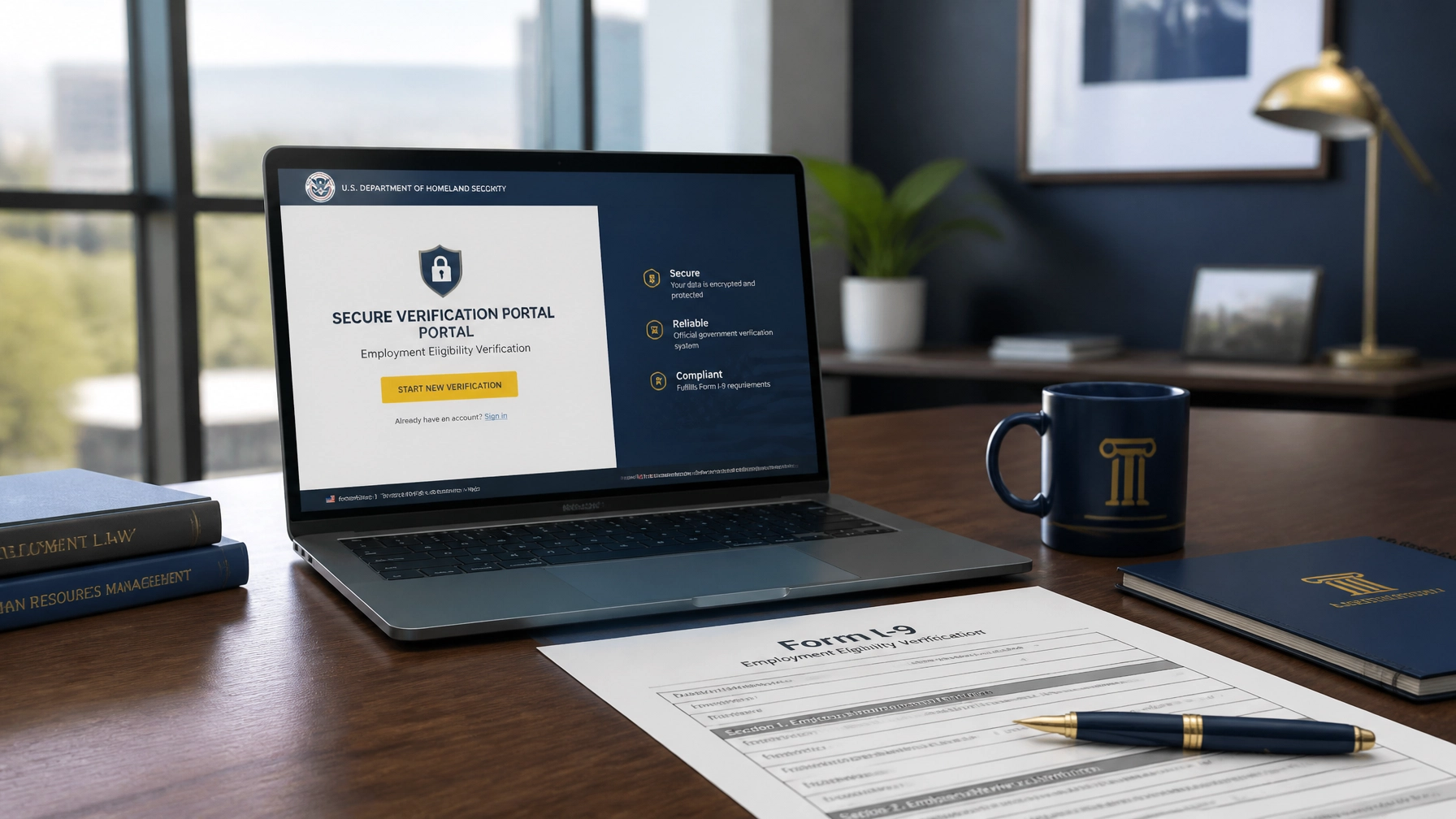
As of July 2026, the regulatory landscape for U.S. employment eligibility verification has undergone significant expansion. For employers, maintaining workforce compliance now requires a dual focus on federal mandates and a rapidly evolving patchwork of state-level requirements. The Department of Homeland Security (DHS) and the Social Security Administration (SSA) continue to enforce E-Verify protocols with increased technical oversight, making it essential for businesses to align their internal processes with the latest legal standards.
Failure to comply with E-Verify mandates can result in severe administrative penalties, the loss of business licenses, and debarment from federal or state contracts. This guide provides a factual overview of the current requirements and best practices for employers navigating these complexities.
Federal E-Verify Mandates for Contractors and Agencies
While E-Verify remains technically voluntary for most private employers at the federal level, certain categories of organizations are legally required to participate.
Federal Acquisition Regulation (FAR) Clause
Employers who hold federal contracts or subcontracts containing the FAR E-Verify clause (FAR 52.222-54) must use the system. Under 2026 regulations, the following timelines apply:
- Enrollment: Contractors must enroll in E-Verify within 30 calendar days of the contract award.
- Existing Employees: All existing employees assigned to work on the covered contract must be verified within 90 calendar days of enrollment.
- New Hires: Any new employee hired to perform work under the contract must be verified within 3 business days of their start date.
Unique Entity Identifier (UEI) and Account Validation
Effective earlier this year, all federal contractors must ensure their Unique Entity Identifier (UEI) is accurately recorded within their E-Verify company profile. Furthermore, the system now requires an annual account validation. Employers must certify their account information every 12 months to maintain access. Failure to complete this certification results in the immediate suspension of case creation capabilities, which may place a contractor in breach of their federal obligations.

State-Level E-Verify Requirements in 2026
The most significant shift in 2026 is the proliferation of state-level mandates. As of this month, over 25 states have enacted laws requiring some form of E-Verify participation for private employers.
States with Universal Mandates
In the following jurisdictions, E-Verify is mandatory for all or nearly all private employers, regardless of size:
- Alabama: Mandatory for all employers with one or more employees.
- Arizona: Required for every employer operating in the state.
- Mississippi: Mandatory for all employers.
- South Carolina: Required for all employers.
Size-Based and Sector-Specific Mandates
Several states tie E-Verify requirements to the number of employees or the specific industry:
- Florida: Following the implementation of HB 197, the threshold for mandatory E-Verify has been strictly enforced. Private employers with 25 or more employees must use the system for all new hires and certify compliance annually.
- Georgia: Mandatory for private employers with 10 or more employees.
- North Carolina: Required for employers with 25 or more employees.
- Tennessee: Mandated for private employers with 35 or more employees.
- Ohio: The E-Verify Workforce Integrity Act, effective March 19, 2026, requires all nonresidential construction contractors and labor brokers to run E-Verify on every new hire. These entities must also adhere to specific record-retention periods, keeping verification data for the duration of employment and at least one year following termination.
Businesses operating across multiple states must consult a business immigration attorney to ensure they are meeting localized thresholds and sector-specific filing requirements.
Integration with Form I-9 Compliance
E-Verify is not a replacement for Form I-9; it is a secondary verification step that relies on the data collected during the I-9 process. Proper I-9 compliance services are foundational to a successful E-Verify program.
Order of Operations
The law dictates a specific sequence for verification. Employers must complete Form I-9, including the physical (or authorized remote) inspection of documents, before a case is created in E-Verify. Cases should be submitted no later than the third business day after the employee starts work for pay.
Remote Inspection Rules
In 2026, the DHS "Alternative Procedure" for remote document examination remains available to E-Verify participants in good standing. This allows employers to inspect documents via live video link rather than in person, provided the employer is enrolled in E-Verify at the time of hire for that specific location.

Technical Updates and System Maintenance
To maintain integrity, the E-Verify system has introduced more rigorous data-sharing protocols.
Identity Matching and Photo Match
The system increasingly utilizes the "Photo Match" feature, which compares the photo on an employee's document (such as a Permanent Resident Card or Employment Authorization Document) against images in government databases. If the Mandatory E-Verify Act of 2026 completes its legislative path later this year, states will be required to share driver’s license photos with the DHS to further enhance identity matching.
Account Certification
Employers are reminded that the annual certification process is mandatory. This process ensures that the contact information for the Program Administrator is current and that the company’s legal entity name matches its tax filings. This is a critical step for maintaining a work visa for foreign employees, as an interrupted E-Verify account can delay the onboarding of critical talent.

Common Pitfalls and Legal Risks
Non-compliance often stems from procedural errors rather than intentional violations. Employers must be vigilant against the following risks:
- Pre-Screening: It is a violation of federal law to use E-Verify to screen job applicants before an offer of employment has been made and accepted.
- Selective Verification: Running E-Verify cases only for employees who "appear foreign" or belong to specific national origins is discriminatory. Verification must be applied consistently to all new hires in a covered location.
- Delayed TNC Resolution: When a Tentative Nonconfirmation (TNC) is issued, the employer must notify the employee and provide them the opportunity to contest the finding. Terminating an employee solely because of a TNC, without following the contestation period, is a violation of the user agreement.
- Reverification Failures: While E-Verify is generally for new hires, employers must still perform timely work authorization reverification on Form I-9 when an employee's temporary authorization expires.

Best Practices for Workforce Compliance in 2026
To mitigate legal exposure, organizations should implement a structured compliance framework.
- Standardize Training: Ensure that all HR personnel responsible for onboarding are trained on the specific E-Verify timeframes and the proper handling of TNCs.
- Conduct Internal Audits: Periodically review I-9 and E-Verify records to ensure that cases were created within the 3-day window and that all required documentation is retained.
- Monitor Legislative Changes: Given the current debate surrounding the Mandatory E-Verify Act of 2026, employers should be prepared for a potential phased-in nationwide mandate that could affect even the smallest businesses within 18 months of enactment.
- Utilize Professional Guidance: Engaging an immigration lawyer to review corporate policies can prevent costly errors during government audits or contract reviews.
Conclusion
The E-Verify system in 2026 is a complex, data-driven environment that demands strict adherence to procedural timelines and technical updates. As mandates continue to shift from voluntary to compulsory at both the state and federal levels, employers must treat verification as a core component of their risk management strategy.
Blasingame Law LLC provides expert guidance on workforce compliance, I-9 auditing, and business immigration solutions. For specialized assistance in aligning your organization with current E-Verify mandates, please contact us to schedule a consultation with a business immigration attorney.