

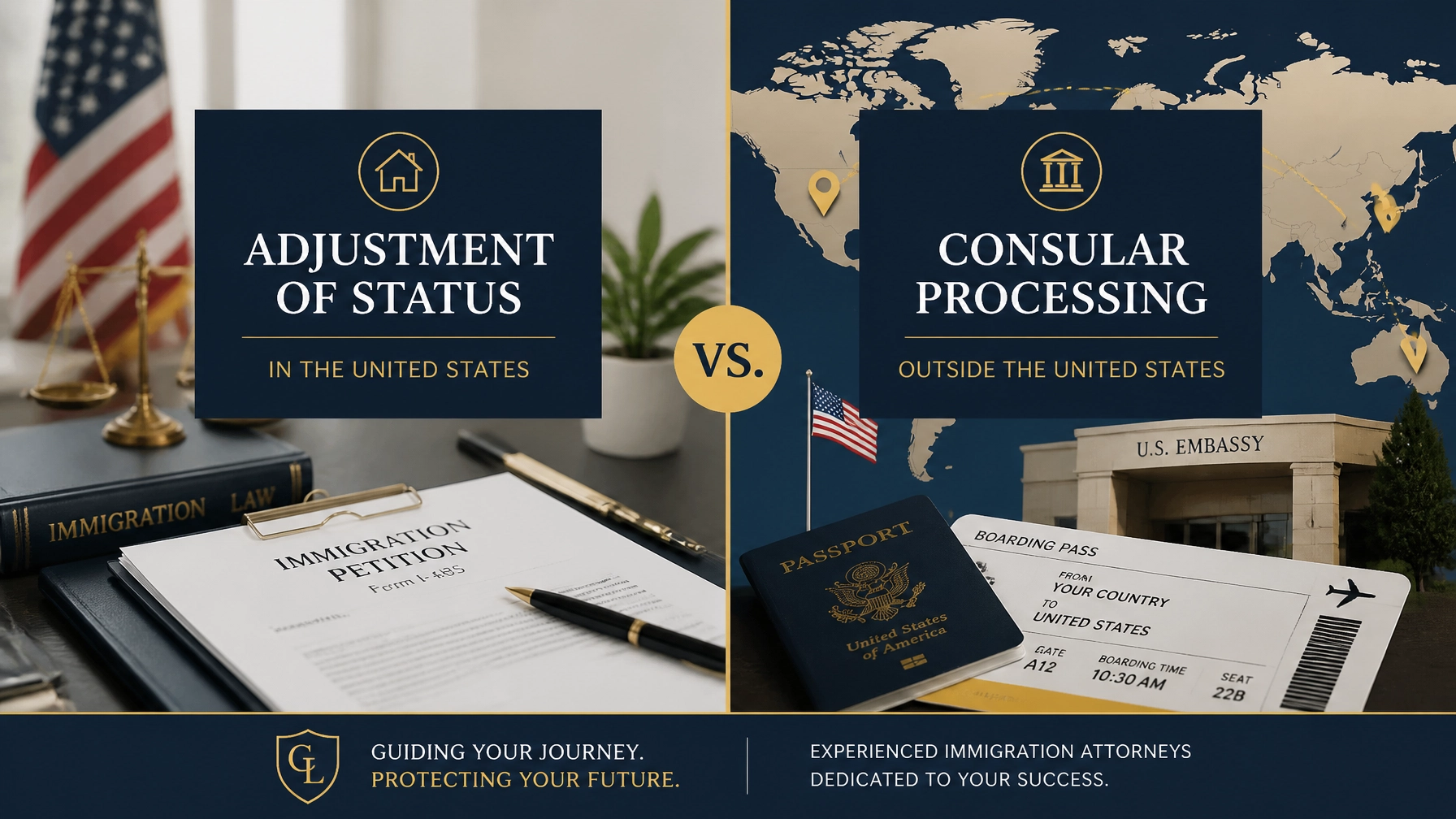
Choosing the correct pathway to permanent residency in the United States is a critical decision that impacts an applicant's legal standing, ability to work, and family stability. In 2026, the two primary methods for obtaining a Green Card: Adjustment of Status (AOS) and Consular Processing: remain distinct in their procedural requirements, timelines, and levels of risk.
While both paths result in the same outcome: Lawful Permanent Resident (LPR) status: the journey to that status differs significantly. This guide provides a formal analysis of both processes to assist individuals, HR departments, and businesses in determining the most effective strategy for their specific immigration needs.
Defining Adjustment of Status (AOS)
Adjustment of Status is the process by which an eligible individual who is already physically present in the United States applies for Lawful Permanent Resident status without having to return to their home country. This process is governed primarily by Section 245 of the Immigration and Nationality Act (INA).
The I-485 Application Process
The core of the AOS pathway is Form I-485, Application to Register Permanent Residence or Adjust Status. To qualify for AOS, an applicant must generally meet three fundamental criteria:
- Physical Presence: The applicant must be physically present within the United States at the time of filing.
- Lawful Entry: The applicant must have been inspected and admitted or paroled into the United States.
- Visa Availability: An immigrant visa must be immediately available to the applicant at the time of filing, as determined by the Department of State’s Visa Bulletin.
The Discretionary Nature of AOS in 2026
It is important to note that Adjustment of Status is considered an "extraordinary" form of relief and is entirely discretionary. In 2026, USCIS has implemented heightened scrutiny regarding this discretion. Under current policy guidance (such as PM-602-0199), adjudicators are directed to closely examine an applicant’s entire immigration history. Negative factors: such as unauthorized employment, minor status violations, or questionable intent at the time of original entry: can lead to a denial of the I-485 application even if the applicant is technically eligible.

Defining Consular Processing
Consular Processing is the standard method for obtaining an immigrant visa for individuals who are currently outside the United States or those who are ineligible to adjust status from within the country. This process involves a U.S. Embassy or Consulate abroad.
The NVC and DS-260
Once a petition (such as an I-130 for family immigration or an I-140 for business immigration) is approved by USCIS, the case is transferred to the National Visa Center (NVC). The applicant must then:
- Complete the DS-260 Electronic Immigrant Visa Application.
- Submit civil documents and financial sponsorship forms (I-864).
- Attend an in-person interview at a U.S. Embassy or Consulate in their home country.
Unlike AOS, Consular Processing is often viewed as the "regular" way to immigrate. If an applicant meets all statutory requirements and is not inadmissible, the issuance of the immigrant visa is generally less discretionary than the AOS process, provided the applicant has no underlying legal bars.
Comparison of Key Factors in 2026
The decision between AOS and Consular Processing involves weighing several logistical and legal variables.
1. Location and Continuity of Life
The most immediate difference is where the applicant remains during processing.
- AOS: The applicant stays in the U.S. throughout the process. This allows for continued employment and family unity without the disruption of international travel.
- Consular Processing: The applicant must travel to their home country for the medical exam and interview. Depending on the consulate's backlog, this stay abroad can last several weeks or months.
2. Employment and Travel Authorization
One of the primary advantages of AOS is the ability to apply for interim benefits.
- Work Authorization (EAD): AOS applicants can file Form I-765 to receive an Employment Authorization Document, allowing them to work for any U.S. employer while the Green Card is pending. This is a vital tool for workforce compliance.
- Travel Document (Advance Parole): Applicants can file Form I-131 to obtain Advance Parole, allowing them to travel abroad and re-enter the U.S. without abandoning their AOS application.
- Consular Restriction: Consular Processing applicants do not receive U.S. work or travel authorization based on their pending immigrant visa application. They must remain abroad or maintain a separate non-immigrant status (like an H-1B or L-1) to work in the U.S.
3. Processing Timelines
As of July 2026, processing times vary significantly by jurisdiction.
- AOS: USCIS field office processing times for I-485s currently range from 8 to 18 months. Heightened scrutiny and interview requirements have contributed to longer wait times in high-volume metropolitan areas.
- Consular Processing: While the NVC stage is relatively standardized, the timeline for an interview is entirely dependent on the specific U.S. Embassy or Consulate. Some posts are currently experiencing significant backlogs, while others are processing cases in 6 to 10 months.

Risk Analysis and Legal Consequences
The legal risks associated with each path must be carefully evaluated before proceeding.
Risks of Adjustment of Status
If an AOS application is denied, the applicant may lose their underlying non-immigrant status. In 2026, a denial of an I-485 often results in the issuance of a Notice to Appear (NTA), placing the individual in removal (deportation) proceedings. This is a critical consideration for applicants who may have "borderline" eligibility due to past unauthorized work or status gaps.
Risks of Consular Processing
The primary risk of Consular Processing is "consular non-reviewability." U.S. consular officers have broad authority, and their decisions to deny a visa are generally not subject to judicial review. If a visa is denied at a consulate abroad, the applicant may be stuck outside the U.S. with no immediate path to return, even if they have family or a job waiting in the United States. Furthermore, if a ground of inadmissibility (such as a prior overstay) is discovered during the interview, the applicant could be barred from re-entering the U.S. for 3 to 10 years.
Strategic Considerations for 2026
For many, the "better" path is determined by their specific legal history and the current administrative environment.
When to Prioritize Adjustment of Status
- Lawful Status Maintenance: If you are currently in the U.S. on a valid visa (e.g., H-1B, O-1, or L-1) and wish to avoid international travel risks, AOS is often the preferred route.
- Immediate Family of U.S. Citizens: Spouses, parents, and unmarried children (under 21) of U.S. citizens are often prioritized for AOS, provided they entered the country lawfully.
- Workforce Stability: Employers should generally favor AOS for key employees to ensure there is no break in work authorization or unexpected delays at a foreign consulate. You can learn more about these strategies in our guide on employment-based green cards vs. work visas.
When to Prioritize Consular Processing
- Applicants Outside the U.S.: This is the mandatory path for those not currently in the country.
- The I-601A Provisional Waiver: Individuals who are in the U.S. but are inadmissible due to unlawful presence may be eligible for a "provisional waiver" before they leave for their consular interview. This waiver is specifically designed for the consular process and cannot be used for AOS.
- Clean Immigration Records: For those with no history of U.S. status violations, consular processing can sometimes be the faster and more "routine" path.

Financial Implications
The cost of each process involves both government fees and logistical expenses.
- Government Fees: Total filing fees for AOS (I-485, EAD, and AP) are generally higher than the combined NVC and consular visa fees. However, these fees are subject to change, and the 2026 fee schedule should be reviewed before filing.
- Logistical Costs: Consular Processing requires international airfare, local accommodations abroad, and medical exams performed by designated "panel physicians" in the home country. For families, these costs can be substantial.
Summary Checklist for Decision Making
Before selecting a pathway, professional consultation is required to evaluate the following:
- Manner of Entry: Was the entry lawful, with inspection and admission?
- Current Status: Is the applicant currently in a valid non-immigrant status?
- Violations: Has the applicant ever worked without authorization or overstayed a visa?
- Visa Availability: Is the priority date current according to the Visa Bulletin?
- Location Preference: Can the applicant afford to be outside the U.S. for 2–4 weeks?

Conclusion
In 2026, the choice between Adjustment of Status and Consular Processing is more than a matter of preference; it is a strategic decision with long-term legal implications. While AOS offers the convenience of staying in the U.S. and the benefit of interim work permits, it carries the risk of removal proceedings and heightened discretionary scrutiny. Conversely, Consular Processing is a more standardized route but involves the uncertainty of foreign embassy backlogs and the risk of being stranded abroad.
Navigating these complexities requires a deep understanding of current USCIS and Department of State policies. Blasingame Law LLC provides expert legal representation and guidance focused specifically on U.S. immigration law. Whether you are an employer managing foreign talent or an individual seeking family reunification, our thirty-plus years of experience ensure your case is handled with the precision and authority required for success.
For a comprehensive evaluation of your Green Card eligibility and to determine the optimal processing path for your situation, contact Blasingame Law LLC today to schedule a consultation.